In my last post, I described the rest of Mom's chemotherapy, which left us at the image here, from August 21, 2014.
This is Mom's tumor (lymphoma) after NINE rounds of chemotherapy. It's still there. It's still very big.
Maybe … maybe that giant mass in Mom's brain is just dead tumor cells? Maybe the chemo really worked?
September 4, 2014. This is a PET scan. It can show how active a tumor is.
The doctor's report said, "There is increased attenuation of the tumor consistent with a hypercellular tumor such as lymphoma. There is intense F D G uptake with a maximal SUV of 27.1. This compares with the normal contralateral right frontal lobe grey matter S U V of 8.6."
The tumor was still very active. (You may have guessed that by how bright the tumor is in the PET scan.)
Incidentally, the doctors made some sort of 3D model of Mom's tumor. After that, it was a very fast process to make this animated GIF.
September 11, 2014. The doctors suggested radiation. This is Mom being fitted with her radiation mask. She needs to lie down like this so that the radiation beams can be aimed precisely where her tumor is (vs. killing healthy brain cells).
A top view. That mask is kinda scary looking, isn't it?
Incidentally, I think the radiologist, Dr. Wheatley, and the fancy machine he'd be using, had arrived at the cancer center only a couple of months earlier.
September 17, 2014. After Mom's first radiation session! If you look closely at the full-size photo (click on it), you can see the marks from the mask on her face.
October 12, 2014. It's Susan Boyle! She was having a concert in Sacramento. Mom felt well enough to go.
The concert was great, by the way. Go, Susan!
October 21, 2014. Mom's second-to-last day of radiation.
In this photo, doesn't Mom look like she's being forcibly tied down? She isn't.
Ok, she was being tied down. Just not forcibly.
Mom had radiation 5 days a week for a month. However, it was much faster and easier than chemotherapy.
By the way, this radiation machine is extremely fancy (and new). It's called the Varian Edge. It sounded like there are less than ten in the United States.
IT MOVES!
Did the radiation work? We'd have to wait six weeks before it was appropriate to do another MRI. (Dr. Wheatley explained this well, but I forgot my notes.)
In the meantime, Mom got to keep her radiation mask as a memento. I used it on Halloween to scare the trick-or-treaters.
Sorry for not posting since December. In this post:
1) A brief recap of previous posts, which include Mom's first 4 chemo rounds.
2) A recommendation: Ken Burns' documentary on cancer.
3) A summary of the rest of Mom's chemo rounds.
4) Miscellaneous info.
1) A brief recap of previous posts, which include Mom's first 4 chemo rounds.
Surgeons tried removing the tumor, but it seemed to grow back in a couple of months.
So, Mom was undergoing chemotherapy. Specifically, she was being given high-dose methotrexate (HD-MTX) and Rituxan (RTX).
Also, Mom was fasting for a significant time for each round of chemo. This was a personal choice based on scientific evidence. The hope was that fasting would both reduce the side effects of the chemo and make the chemo more effective at fighting her cancer.
I had given details through Mom's 4th round of chemo. (June 10, 2014: 6 g/m2 MTX. No side effects!)
2) A recommendation: Ken Burns' documentary on cancer.
As noted earlier, Mom's 4th round of chemo was on June 10, 2014. She was given 6 g/m2 MTX, and there were no side effects. (She was also given RTX each round, which never had any side effects.)
Round 5: June 24. MTX: 8 g/m2. No side effects.
Round 6: July 8. MTX: 8 g/m2. No side effects.
Round 7: July 22. MTX: 8 g/m2. No side effects.
Round 8: August 5. MTX: 8 g/m2. No side effects.
Round 9: August 19. MTX: 8 g/m2. No side effects.
This was good. Mom was able to tolerate more chemotherapy on a regular basis, without side effects. Many of the nurses commented on how well Mom seemed to be doing. Whether this was due to the fasting, to subtle changes in the way they gave the chemo, or to both, we don't have enough data to know.
But was the chemo (and fasting) doing its job? Was it killing the cancer cells? We now had MRIs from May 20, July 10 and August 21:
If you compare the MRIs, you'll see that Mom's tumor shrunk a little between May and July, corresponding to chemo rounds 3–6. However, Mom's tumor was the same (or bigger…) after chemo round 9. The chemo had stopped working. This wasn't good.
Mom's nine rounds of chemo took just over 5 months. Anecdotally, I'd heard that a lot of chemo stops working after about 6 months. I don't know how often that happens, or even why that might happen. But if it's true, it's unfortunate that there were complications in the early rounds of Mom's chemo. Those delays could have reduced the amount of effective chemo that Mom could have received. Also, receiving chemo more quickly could have reduced the amount that the tumor grew after surgery. (Remember that it seems the tumor grew back in only 2 months.)
On the other hand, what's done is done. Everyone makes mistakes. In fact, that's how we learn—and remember—what's important. Next time, we'll certainly make more mistakes. But our mistakes will be better.
A PET scan on September 4 would prove that Mom's tumor was still very active. That's a terrifying thought.
Next time, in Fighting Cancer, part 7: Radiation.
4) Miscellaneous info.
Testing urine:
For Mom's chemo, it was important that she be given MTX only when her pH was above a certain level.
Why?
MTX is more soluble at higher pH. If Mom was given a lot of MTX while her pH was too low, or if her pH dropped too low while being given MTX, that could cause the MTX to crystallize out and damage her kidneys. (This happened in the first round, which is how we learned about it.)
The nurses measured the pH of Mom's urine at 6-hour intervals, and those results sometimes took a few hours to come back. Several times, Mom's pH seemed to drop to a dangerous level, but we'd find out only hours later. Somehow, I had the idea that we could test Mom's urine ourselves.
In the photo above, I'm in Mom's hospital room, testing the pH of her urine. (I owe my Ph.D. training for not being afraid to do this. Not that I tested urine for my Ph.D.…)
We used pH paper that we found online and, of all places, from the Sacramento Natural Foods Co-Op. This way, we could have immediate results every few hours, instead of waiting eight hours. If anything seemed amiss, we could then notify the nurses right away.
After we started measuring Mom's urine on our own, I don't think we ever found anything wrong. Nevertheless, I felt a lot better that we were measuring it. Our results ended up being a lot faster and more consistent than what we got from the hospital lab. (And measuring urine may sound gross, but it's actually quick, easy and safe once you know how.)
Chemo wasn't too bad:
I'm not sure how Mom fasted so much; she basically drank only water for four full days, and she did this every two weeks. But beside that, the later chemo rounds were uneventful.
Here, Mom is reading the newspaper in the hospital courtyard. It seemed crazy to me to drag the IV outside, but in the end it was fine.
February 22: Mom has brain surgery. Surgeon thought he removed all/most of the tumor.
March 17: First round of chemotherapy. Mom's kidneys are almost destroyed from methotrexate poisoning.
That's where we left off. Poor Mom. Methotrexate (MTX) is a chemo drug and was supposed to help her by killing the cancer. But instead it almost killed her. And she didn't get even a full dose of MTX: She got 3 g/m2, when you're supposed to get 8 g/m2.
What now? Try MTX again? Something different? Give up? Dr. Quadro, the oncologist, felt MTX was still our best chance. We'd wait for Mom's kidneys to heal, then try again with a lower dose of MTX (1.5 g/m2), given over a longer period of time (24 h instead of 4 h). The doctors made clear that there was a "risk of renal failure."
I still wanted Mom to fast during chemo, and this time more stringently: *Only* water, not even organic chicken broth. And for a longer time. Like Dr. Quadro, I felt fasting was still our best chance. In hindsight, I'm not sure I understood how damaged Mom's kidneys had been. If I had, I might not have pursued the fasting so much. Then again, it was ultimately Mom's intuition and decision.
We had to wait over a month for Mom's kidneys to heal, so we could try chemo again; ideally it'd be every 2 weeks.
On top of all that, I wouldn't be with Mom in the hospital, again. Last time I was at the Game Developers Conference (GDC). This time, Mom had previously arranged for her brother to fly in from Seattle and remodel part of the house. I would be helping full-time on the construction.
What happened?
April 25: Second round of chemotherapy. No side effects!
The construction was quite a handful, actually. We got way behind schedule, and we were probably over-budget. But I learned a lot, and no one got seriously hurt.
Here's Mom in her renovated bedroom. Can you see her? Mom's vision was getting a lot worse, so we replaced the dark carpet with brighter laminate flooring. Then we added the track lights and the pendant light.
And we knocked out one wall and put in two more….
Since chemo round 2 went a lot better, should we try more MTX? Dr. Quadro wanted another MRI, since Mom hadn't had one since going to the ER. Maybe the MRI would show that the surgery plus the MTX had gotten rid of the tumor.
May 20: MRI of Mom's brain shows tumor still present, slightly smaller than before surgery.
Here are the pre-surgery (Feb. 20) and current MRI (May 20) pics, side-by-side:
If you think about it, this is at best, odd, and at worst, scary. The surgeon thought he removed all of Mom's tumor, which was large. And we had two rounds of chemo. Shouldn't the tumor be a lot smaller or completely gone?
Possible explanations:
The tumor is gone, and that's just scar tissue. (A PET scan later would rule this out.)
The tumor was mostly removed, but it grew back very, very quickly, and the chemo shrunk it a little.
The tumor was mostly removed, but it grew back very quickly, and the chemo didn't do much.
A relatively large portion of the tumor wasn't removed (perhaps it looked like regular brain tissue), so the tumor grew back "only" quickly, and the chemo may or may not have done much.
As you can see, none of those explanations is comforting. Mom's cancer is Primary CNS Lymphoma (PCNSL), and it turns out that lymphomas can grow very rapidly.
But if the lymphoma can grow from nothing to that size in 3 months, what happens in another 3 months? Or even 1 month?
We decided to try more chemo. And fasting.
May 27: Third round of chemotherapy. Back to 3 g/m2 MTX. No side effects!
Once more, with feeling:
June 10: Fourth round of chemotherapy. 6 g/m2 MTX. No side effects!
At least we were getting back on track. The original goal of 8 g/m2 MTX, every 2 weeks, was in sight. Dr. Quadro's switch from spreading the MTX over 24 hours instead of just 4 hours seemed to work, in terms of Mom tolerating the chemo. And the fasting didn't seem to hurt, either.
But was the chemo really killing the cancer? Had the lymphoma quickly grown back, but now the MTX was killing it? Or was the MTX not working, and the lymphoma was regrowing? We really didn't know, but we kept giving it our best shot.
Next timeline:
June 24: Fifth chemo.
Measuring Mom's urine.
July 8: Sixth chemo.
July 10: MRI scan.
Notes:
For each chemo, Mom received not only MTX but also a drug called Rituxan. Actually, my old workplace, Genentech, makes it. Rituxan's a great drug, but it doesn't cross the blood-brain barrier that well….
Mom would continue fasting for each round of chemo. Starting with the second round, she would fast for 48 hours before chemo, until 24 hours after the end of receiving chemo. With a 24-hour methotrexate infusion, that meant each chemo round, Mom spent AT LEAST 96 STRAIGHT HOURS fasting: no food/juice/etc., only water.
Mom actually kept a very good attitude during this time, as I recall. Where's a Mom happy picture? Here's one!
February, 2014: Mom has a brain tumor.
March 17, 2014: First chemotherapy.
Last time, I presented a real-life, personal medical mystery. Mom's chemotherapy was supposed to happen a certain way, but it didn't. So what happened, and why?
Our specific expectations and timeline were:
Mom starts water-only fast for 48 hours before chemo.
Geoff goes to Game Developers Conference (GDC) for 1 week.
March 17: Mom starts first chemotherapy.
Mary stays with Mom in hospital.
Muriel and Ron come to town.
Hospital staff puts PICC line into Mom.
Inject/infuse sodium bicarbonate continuously until Mom's urine is pH > 7.9.
Infuse methotrexate at a high dose (3 g/m^2, or 4.8 g in Mom's case) over 4 hours.
Wait 24 hours, then infuse leucovorin.
Infuse Rituxan.
Keep fasting until 24 hours after chemo.
Wait a couple days until chemo out of Mom's body. Mom goes home.
Geoff returns from GDC.
Knowing something went wrong with Mom's chemo, you might read the above list and jump to conclusions about the cause. For example, why is Mom fasting for chemo, especially her first one (step 1)? Why is Geoff leaving town during that time, especially for a "game conference" (step 2)? If you knew a little more, you might question why we're giving Mom two drugs the first time (methotrexate and Rituxan) (steps 8 and 10)? Why are we changing Mom's pH (step 7)? Why are we starting with a "high dose" of chemo (step 8)? Why put in a PICC line (step 6)?
You can say, "Why is Mom fasting?" in two very different ways. You can ask it as a straightforward question, like when a child asks, "Why is the sky blue?" Or you can ask it as more of a judgment, like when Judge Judy asks, "Why did you leave your child with a stranger?" The problem with judgment-questions (which aren't really questions at all) is that your bias clouds your judgment. If you're actually wrong, or only half-right, you may be too biased to see it.
I emphasize this point because I see it so often, and it's not helpful and can be very harmful. For example, it can lead one to stop something good because of fear: a PICC line, Rituxan, and dare I say, fasting during chemotherapy. If you find yourself jumping to conclusions, take a step back and try to ask the question as a real question.
For Mom's first chemo, all the above are good questions but bad conclusions, because something else in that timeline was the real cause.
Photo break! Mom and our friend Jenny from Hope for Horses in Seattle. January 27, 2014. Full photo here.
The doctors had to figure the cause in real-time, but we'll use hindsight. Mom was supposed to be in the hospital for 4 days. Instead, she was there for 12. Here's the discharge diagnosis after Mom's chemo:
Diffuse B-cell lymphoma with central nervous system involvement status post chemotherapy.
Acute renal insufficiency secondary to methotrexate toxicity.
Wegener's granulomatosis followed by Dr. Barger.
Hypertension, started on metoprolol.
Hyperglycemia likely secondary to steroid.
Hypocalcemia.
What's that saying? 1) is Mom's cancer: PCNSL (Primary CNS Lymphoma). 2) says Mom's kidneys were poisoned, because of the methotrexate. 3) is a pre-existing autoimmune disease Mom's had for years. 4) is, well, hypertension. 5) says Mom has high blood-glucose levels (which can lead to diabetes), probably due to steroids she's on. 6) says Mom has too little calcium in her blood.
What happened is that Mom's chemo started more-or-less as planned. She fasted a little, the PICC line was put in, her pH was increased, methotrexate was given, then leucovorin, then Rituxan. However, Mom's kidneys started to fail. (Our kidneys remove toxins and waste from the body. If our kidneys fail, we need to be put on dialysis or we'll die.)
Why did Mom's kidneys fail? At first, some of the doctors thought it might be Tumor Lysis Syndrome (TLS). But Mom's oncologist, Dr. Quadro, now believes it was due to the methotrexate. However, it wasn't due to the *high dose* of methotrexate (3 g/m^2, or 4.8 g); it was due to the TIME (given over 4 h). For example, if the same dose were given over 24 hours, Mom's kidneys would've been fine.
That's a very important distinction. We needed a high dose of methotrexate to fight Mom's brain tumor. If one assumes the high dose was poisonous to Mom's kidneys, we could lower the dose, but that would lower the effectiveness of the treatment. A better solution is to maintain the high dose and increase the time over which that dose is given.
You might be wondering, how will increasing the time span affect the effectiveness? Think about that for awhile, and I'll answer at the end. (It's a good mental exercise, in case you ever know someone who has cancer.)
Photo break 2! Me, Jenny, Auntie Nancy and Mom at Hope for Horses. November 6, 2014. Full album here.
It's hard to be certain in medicine. Each patient is individual, and each body changes over time. So why do we think Mom was poisoned due to the time-span of the methotrexate? Why wasn't it the amount of methotrexate? Or the fasting? Because in later rounds of chemotherapy, Mom fasted even more and had even more methotrexate (but over 24 hours, not 4 hours) and everything was fine.
So, Mom almost died from her first round of chemotherapy. The methotrexate was too concentrated for her, and the methotrexate probably formed tiny crystals in her kidneys, damaging them. It would take a long time for those crystals to dissolve and for Mom's kidneys to heal. The fallout included:
Mom's extended stay in the hospital (12 days instead of 4).
They had to give Mom a special drug (glucarpidase) to treat the poisoning, and it cost tens of thousands of dollars.
Mom had to wait almost 6 weeks before she recovered enough to get her next chemo (her chemo should've been every 2 weeks).
For the next several chemos, we had to give less methotrexate than the doctor would have liked, because Mom was still recovering (and we weren't sure how much she could take). This meant less chemo attacking the cancer cells.
Not a great start to chemo.
To clarify, I'm not mad at the doctors for Mom's methotrexate poisoning. PCNSL has been treated with methotrexate at both 4 hours and 24 hours, so the doctors were following a standard. At the time, I didn't know anything about Mom's chemo and I didn't think about the time span, so we didn't object. And 4 hours is definitely less waiting for the patient. On the other hand, Mom is older than the average PCNSL patient. Also, she's had quite a few other medical issues, including Wegener's granulomatosis for over 20 years.
Everyone makes mistakes. That's how we grow. We grow, learn and keep going.
Back to a question: How will increasing the time span of a drug affect its effectiveness? In particular, giving 4.8 g of methotrexate over 24 hours instead of 4 hours? If a drug needs to reach a certain concentration in the body, then a shorter duration may be better. Perhaps that's the case for drugs to cross the blood-brain barrier (BBB), but I'm not sure. On the other hand, giving a drug over a longer period of time can be more effective. Why? Why isn't the same amount of drug the same effectiveness?
My understanding is that methotrexate works at certain stages of the "cell cycle." Also, a tumor is a mass of cells (think of a ball), so the methotrexate can kill only the outer layer of cells per cell cycle. The longer the drug duration, then the more times the drug can kill the outer layer of cells, let those cells be shed, kill the next outer layer of cells, and so on.
Feel free to spend time with the chart above. The horizontal axis is increasing amounts of methotrexate. The vertical axis (Viability) is how well the cells survived. As we're interested in killing cancer cells, lower values are better. The lines connect experiments done with the same drug duration (e.g., 3 h, 6 h, 18 h).
In that chart, compare the red and blue circles. The red circle is cells in 100 µM methotrexate for 3 h; about 10% survived. The blue circle is 0.1 µM methotrexate for 42 h; less than 1% survived. Imagine that: one can give 1000x less drug but still get *much better* results than before simply by waiting 14x as long.
Since we're looking at charts, I want to end this post by re-explaining a graph from last time. I'll try to be clearer.
First, this graph is showing something different from the chart way above, so cast that out of your mind. Here, the horizontal axis is how many days have passed. The vertical axis (% Survival) is how many mice survived in a given group. There are 3 groups: "Control," "Chemo-cocktail" and "Fasted/chemo-cocktail." All 3 groups had cancer. The Control group had no chemo. The Chemo-cocktail group had a cocktail of chemotherapies. The Fasted/chemo-cocktail group fasted before receiving the same chemo-cocktails as the previous group. The graph also has notations that fasting was done on Day 7 (for the group that fasted), and chemo was given to all groups around Day 9.
Each line on the graph follows one of the groups as it goes from 100% alive on Day 0 to x% alive after so many days. (That's why all three lines are always decreasing, never increasing.)
I've circled three points on the graph and will describe them below. If you can figure out which description fits each circled point, you'll have gained a good understanding of the graph.
After ~27 Days, the entire Control group was dead.
After ~45 Days, ~18% of the Chemo-cocktail group was still alive. Chemo was much better than doing nothing.
After ~52 Days, ~50% of the Fasted/chemo-cocktail group was still alive. This was much better than doing only chemo!
Whew! Mom's first chemo was a trial, but we made it through. Don't worry; I hope to summarize subsequent chemos more quickly. =)
February 19, 2014: Mary takes Mom to ER. Doctors find brain tumor. Hopeful diagnosis is benign meningioma.
February 22: Mom has brain surgery to remove tumor.
February 25: Doctors analyze tumor tissue and find not benign meningioma. Rather, tumor is malignant, Primary Central-Nervous-System Lymphoma (PCNSL).
Mom stays in hospital to recover from brain surgery. She has much physical therapy, etc.
March 8: Mom discharged from hospital.
March 17: Mom's first chemotherapy scheduled.
Do you like detective shows? Mom does. When I was a kid, we watched "Murder, She Wrote," "Crazy Like a Fox," "Perry Mason," "Columbo," etc. It's fun (and mental exercise) to figure out the mystery. Of course, TV is contrived. Treating cancer can be a real mystery.
I was going to describe Mom's first chemo session in one post. However, there are too many important details, so this will be a two-parter. In this first post, I'll explain everything we expected to happen ("Six strangers arrive at a dinner party…"), and I'll give you the outcome ("Mr. Boddy was found dead in the library!"). In the second post, I'll explain what happened in between. Can you figure it out before then?
Previously on "Fighting Cancer"….
Last post, I said my mom's medications may have led to her cancer. I found a specific reference in one of the doctor reports: "Patient by history apparently had received Cytoxan in the past for her Wegener's granulomatosis."
Cytoxan is a trade name for cyclophosphamide. More info on cyclophosphamide is here. If you search that article, you'll find it mentions both Wegener's and lymphoma.
Expectations.
Now that we knew Mom had PCNSL, Mom needed chemotherapy. That's because surgery is unlikely to completely remove PCNSL: microtumors may have formed in other parts of the brain or other parts of the body. If the doctors had known my mom has PCNSL, they would have skipped brain surgery and gone straight to chemo.
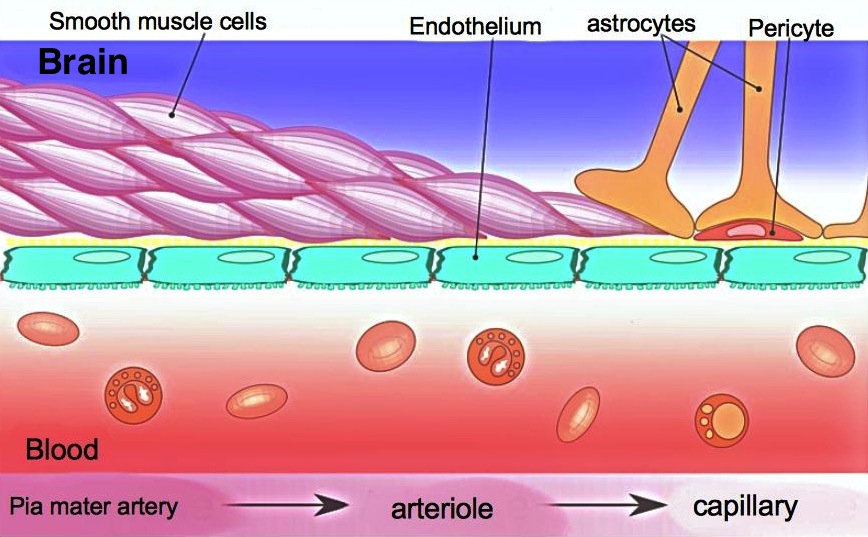
The main problem with brain tumors is the Blood-Brain Barrier (BBB).
What's the BBB? Well, your brain needs oxygen and other stuff, just like the rest of your cells. So there are blood vessels (capillaries) running throughout your brain to reach all the cells and give them nutrients, remove waste, etc. However, each of these capillaries is naturally lined with the BBB. The BBB is supposed to allow the proper things through (e.g., water, glucouse, oxygen) while blocking improper things. In particular, bacteria and viruses are blocked, so the brain doesn't get infected.
The BBB is basically the blue cells in the middle.
The BBB prevents bacterial infection, but what happens when bad things are already in the brain (e.g., tumors)? Most chemotherapy drugs can't pass the BBB. The solution is crude: more chemo. By giving much more chemo than normal, we hope enough chemo will get into the brain to kill the tumor cells.
Mom's chemo would have four main components: sodium bicarbonate, methotrexate, Rituxan and leucovorin. Methotrexate is a potent chemotherapy drug from the 1950s; it kills rapidly dividing cells, including cancer cells but also bone marrow and skin. Sodium bicarbonate (baking soda) is used to make one's blood more basic or alkaline, because methotrexate is more soluble that way. Leucovorin is basically the antidote to methotrexate; once leucovorin is used, methotrexate is neutralized. Rituxan is a fancier drug from the 1990s. As a simple comparison, a Rituxan molecule is about 300 times as big as a methotrexate molecule. Rituxan is generally safer than methotrexate, but Rituxan can have problems at the start of an infusion.
The plan was to inject sodium bicarbonate into Mom until her urine was pH > 7.9. Then, they'd inject methotrexate at a high dose over 4 hours. They'd wait 24 hours, then give the leucovorin. Finally, they'd inject Rituxan.
Mom's blood would be checked at least daily and she would be watched for adverse side effects. After a couple days, the methotrexate should be completely gone (via urine). Then she could go home.
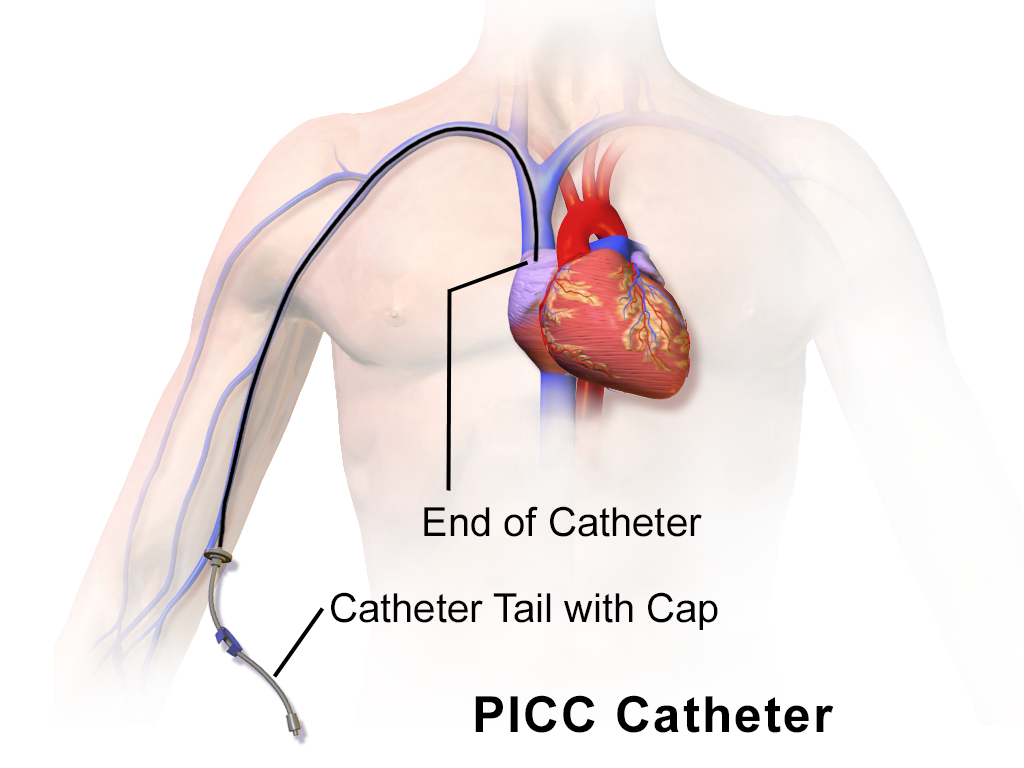
To facilitate all the injections and blood draws, they wanted to install a PICC line (pronounced "pick"). PICC = Peripherally Inserted Central Catheter. A PICC line is a tube that goes from a vein in your arm all the way to your heart:
The PICC is basically a long-term IV. Once a PICC has been installed, a nurse can draw blood or inject drugs without having to poke the patient anymore. Precautions must be taken to make sure the PICC stays in place and does not get infected.
On top of all this, I wanted Mom to fast for 72 hours.
Fasting is used by many people for many reasons. Mine was specific: in February 2012, I ran across a scientific article entitled, "Fasting Cycles Retard Growth of Tumors and Sensitize a Range of Cancer Cell Types to Chemotherapy." I would almost summarize the paper as showing, "Fasting Cures Cancer!" (I'm not saying that, at least legally.) The paper had two graphs I found particularly compelling:
Both graphs describe mice with a cancer called neuroblastoma. In the first graph, some mice were given the chemotherapy drug doxorubicin (DXR), and some also fasted. In the second graph, some mice were given a "chemo-cocktail" of DXR and the drug cisplatin, and some also fasted.
How do you read these graphs? Let's take the second one (also below). Focus on the "Control" part, which is the black line marked with circles. These are mice with cancer and no chemotherapy, no fasting. There's a circle at 0 Days/100% Survival, then circles at 22 Days/65% Survival, 23 Days/50% Survival and 26 Days/0% Survival. That means all the mice were alive at Day 0, then some died on Day 22 (65% left), more died on Day 23 (50% left), and the rest died on Day 26 (0% left). All mice lived less than 26 days.
Now focus on the "Chemo-cocktail" part, the blue line marked with triangles. Mice died on Days 10, 11, 40, 60 and 70. In particular, you can see that some mice died early (Days 10 and 11), but the rest lived longer than the controls (40–70 days). The chemo hurt some mice but helped others. All mice lived less than 70 days.
Finally, look at the red line (upside-down triangles). That's mice that were given chemo and which also fasted. The first mouse doesn't die until Day 30, which is better than every single mouse in the control. Just as important, ~25% of the mice lived past Day 75, which is better than every single mouse who received chemo only. In fact, those 25% were still alive past Day 300, at which point they presumably stopped the experiment because those mice might live for years.
Now, imagine those mice were like people and given a choice. They're already going to get chemo, which is a big step. Should they choose also to fast? ("Isn't chemo a big enough change already?" "Fasting for 72 hours sounds dangerous, especially when getting chemo.") That choice could be the difference between two very different futures: in one, you're at someone's grave because they lived a bit longer but still died from cancer; in the other, that person became cancer free and is still with you. Compare the blue line to the red line.
One could add several caveats to what I just said. But the bottom line is that I remembered that article from February 2012 and kept a copy on my computer. If I ever got cancer, I'd seriously consider fasting.
By the way, here's a video by the article's author, Dr. Valter Longo, summarizing their results:
When they found Mom's cancer, I thought about those graphs and the consequences of not speaking up. I pushed for Mom to fast, for 72 hours. (In the article, the mice had only water, for 48 hours before chemo and 24 hours after.)
Mom agreed. Our main oncologist, Dr. Quadro, didn't veto it.
The final kicker is that I didn't plan to be around while all this was happening.
Ever have an annual tradition? Maybe a trip to Hawaii, or Thanksgiving at Grandma's. What about a tradition that can truly happen only once a year? Maybe Black Friday Shopping. Or a Monarch butterfly migration. For me, that's the Game Developers Conference (GDC).
I attended my first GDC in 1998, when just a junior at Cal. I've been back almost every year since, and many friends I see only at that conference. Part of me still really wanted to go this year, and I had already committed to volunteering there for the entire week.
Thankfully, Mary said she would help Mom during this time. Mary would even stay in the hospital overnight with Mom. And my uncle Ron and auntie Muriel would also come to town to help out.
So, these were our expectations and timeline:
Mom starts water-only fast, 48 hours before chemo.
Geoff goes to Game Developers Conference (GDC) for 1 week.
March 17: Mom starts first chemotherapy.
Mary stays with Mom in hospital.
Muriel and Ron come to town.
Hospital staff puts PICC line into Mom.
Nurses inject/infuse sodium bicarbonate continuously until Mom's urine is pH > 7.9.
Nurses infuse methotrexate at a high dose (3 g/m^2, or 4.8 g in Mom's case) over 4 hours.
Nurses wait 24 hours, then infuse leucovorin.
Nurses infuse Rituxan.
Mom keeps fasting until 24 hours after chemo.
Everyone waits a couple days until chemo out of Mom's body.
March ~20: Mom goes home.
March 22: Geoff returns from GDC.
Reality
Here's how things ended up:
Mom starts organic-chicken-ginger-broth fast, 48 hours before chemo.
Geoff goes to Game Developers Conference (GDC) for 1 week.
March 17: Mom starts first chemotherapy.
???
March 28: Mom discharged from hospital.
The medical report is 686 pages. The discharge diagnosis says:
Diffuse B-cell lymphoma with central nervous system involvement status post chemotherapy.
Acute renal insufficiency secondary to methotrexate toxicity.
Wegener's granulomatosis followed by Dr. Barger.
Hypertension, started on metoprolol.
Hyperglycemia likely secondary to steroid.
Hypocalcemia.
That doesn't include Mom's eye problems (retinal lesions).
Can you figure out what happened during Mom's first chemotherapy?
(Possible hint: at some point, Mom was scheduled to also receive rasburicase and glucarpidase.)
More importantly, can you guess *why* things happened? And what should change for the next chemotherapy? What would you do if you or your loved one was about to get chemo?
Recently, Mom asked me more about how her surgery had gone. Of course, she wasn't awake during the actual surgery. But also, because of possible brain injury, she has trouble remembering things. Shucks, even I have trouble remembering things. So, I'll go back a bit.
Mom has an autoimmune disease called Wegener's Granulomatosis (WG). Nowadays, it's been renamed to ANCA-Associated Vasculitis. Honestly, you can google for any info I could provide you. I will say that Wegener's is an autoimmune disease, not to be confused with something like AIDS: Acquired ImmunoDeficiency Syndrome. I know they sound similar, but they're almost opposites: In an autoimmune disease like Wegener's, your immune system is almost on auto-pilot and attacks everything in sight, including your own cells. Your immune system is doing *too much.* In an immunodeficient disease like AIDS, your immune system is weak/destroyed. Your immune system is doing *too little.*
Besides Wegener's, another example of an autoimmune disease is systemic lupus erythematosus, AKA lupus.
So, Mom's had Wegener's for many years. And in recent years (2012, 2013), her vision started to deteriorate. That can come with Wegener's, but Mom's Wegener's was apparently stable. So they did an MRI of Mom's head:
That was on 9.28.2012. The left side of the brain is on the right, and vice versa. You can tell by the "R" and "L" notations on the image.
On the left side of the brain, do you see that tumor? I don't, either. Nor did the doctors. If it was there, it wasn't apparent.
Mom's eyesight continued to deteriorate in 2013, and no one had a good explanation nor solution. She even traveled to specialists in Portland and Minnesota. (The latter being the famous Mayo Clinic, which my mom did enjoy.)
All this was also happening while Mom was taking care of Grandma. We all miss Grandma Fong.
Grandma died on Christmas Day, 2013. On February 19, 2014, a Wednesday, my sister took Mom to the ER. They did a CT that evening and another MRI the next evening. They saw this:
It's ~500 days from the earlier MRI. Or 1 year, 5 months.
I've put the earlier MRI below to compare more easily.
I lined up the slices as well as I could.
Of course, now that I look at the slices lined up, I wonder if I do see something? But I know nothing about brain images, so I'll just quote the report summary from 9.28.2012.
IMPRESSION: 1. No evidence of intraorbital or intracranial involvement with Wegener's granulomatosis. 2. Extensive white matter nodular changes within the corona radiata and centrum semiovale, nonspecific, but presumably related to aging.
The MRI from 2.20.2014 reports the tumor as "5.9 cm x 4.2 cm x 5.3 cm." They also said it was most likely a meningioma. (That would have been a better diagnosis.)
Anyway, Mom wanted to know about the surgery. My notes say the surgery happened on February 22, a Saturday, starting at 8 AM, lasting several hours. The doctors removed (resected) as much of the tumor as they could, and they also tested the tumor tissue to know exactly what kind of cancer it was. The diagnosis would come back as Primary Central-Nervous-System Lymphoma (PCNSL). Also, they did another CT on February 23 to see how things looked after surgery:
Of course, now Mom had to heal from her surgery. She had some major stitches. I feel like Mom went through every department in the hospital, as she was in op, post-op, acute rehab, rehab, and probably oncology and who knows what else.
Mom was discharged on March 8, 2014, a Saturday. From the day my sister took Mom to the ER, that's 18 days. If anything, I'd say that Mom's good at rolling with the punches. (Grandma was, too.)
Mom still had a lot of rehabilitation and recovery to do. And, as the tumor was not a meningioma but instead this metastatic lymphoma, Mom needed more treatment. Next up: chemotherapy on March 17, 2014. That was also the start of the Game Developers Conference (GDC), my favorite conference of the year. Should I still go? Would I still go?
One more thing before ending this post. Remember how I said Wegener's is an autoimmune disease, and pretty much the opposite of AIDS, an immunodeficient disease? Well, if you google primary CNS lymphoma, you'll find that PCNSL usually occurs in immunodeficient people. That's right, immunodeficient (aka immunocompromised). So why did Mom get PCNSL, when she should have an overactive immune system? My understanding is that Mom's immune system has been essentially compromised/deficient/suppressed, because she's been on medications, for several years, that suppress her immune system. So, yeah, the drugs my mom was given probably led to her cancer. That said, Mom almost died from Wegener's over 20 years ago.
We'll just keep rolling with the punches and doing our best.
In February 2014, my mom was diagnosed with a brain tumor:
That blob is a 6 x 4 x 5 cm malignant tumor. Here's a top-down view:
Judging from the images above and other data, the doctors first thought Mom's tumor was benign. They thought it was a "large meningioma"; big but relatively easy to remove.
On February 22, 2014, Mom had brain surgery. The doctors removed as much of the tumor as they could. Below is a picture from the day after surgery.
You can see a bit of the space where the tumor was, and also where they cut into Mom's skull to get to the tumor.
Now that the doctors had cut out the tumor, they could examine it under the microscope to get a better diagnosis. Unfortunately, the doctors discovered that the tumor was not a meningioma, but rather "primary CNS lymphoma." What's that?
• "Primary," as opposed to secondary, means that's where the cancer started. I think that's good; if it were secondary, you'd have to search for the primary tumor, and you'd need to handle two tumors. (No secondary tumors have been discovered in Mom, yet.)
• "CNS" is "central nervous system." That's the spinal cord or brain.
• "Lymphoma" is a cancer of one's white blood cells. White blood cells are part of our immune system and are found throughout our body.
To summarize, some of Mom's white blood cells turned cancerous, and they formed a tumor in her brain. This tumor was malignant, which is bad on a couple levels: 1) It probably grows relatively quickly, and 2) it can spread to other parts of the body. Because of this, the doctors decided we had to do more than just surgery to get rid of Mom's cancer.
Next time: "Fighting Cancer: Chemotherapy. And Fasting."
P.S. Some statistics on primary CNS lymphoma: It's rare: 4 cases per 1,000,000 people. Survival rate: I've seen different quotes. From 10–18 months to > 4 years, for example.